
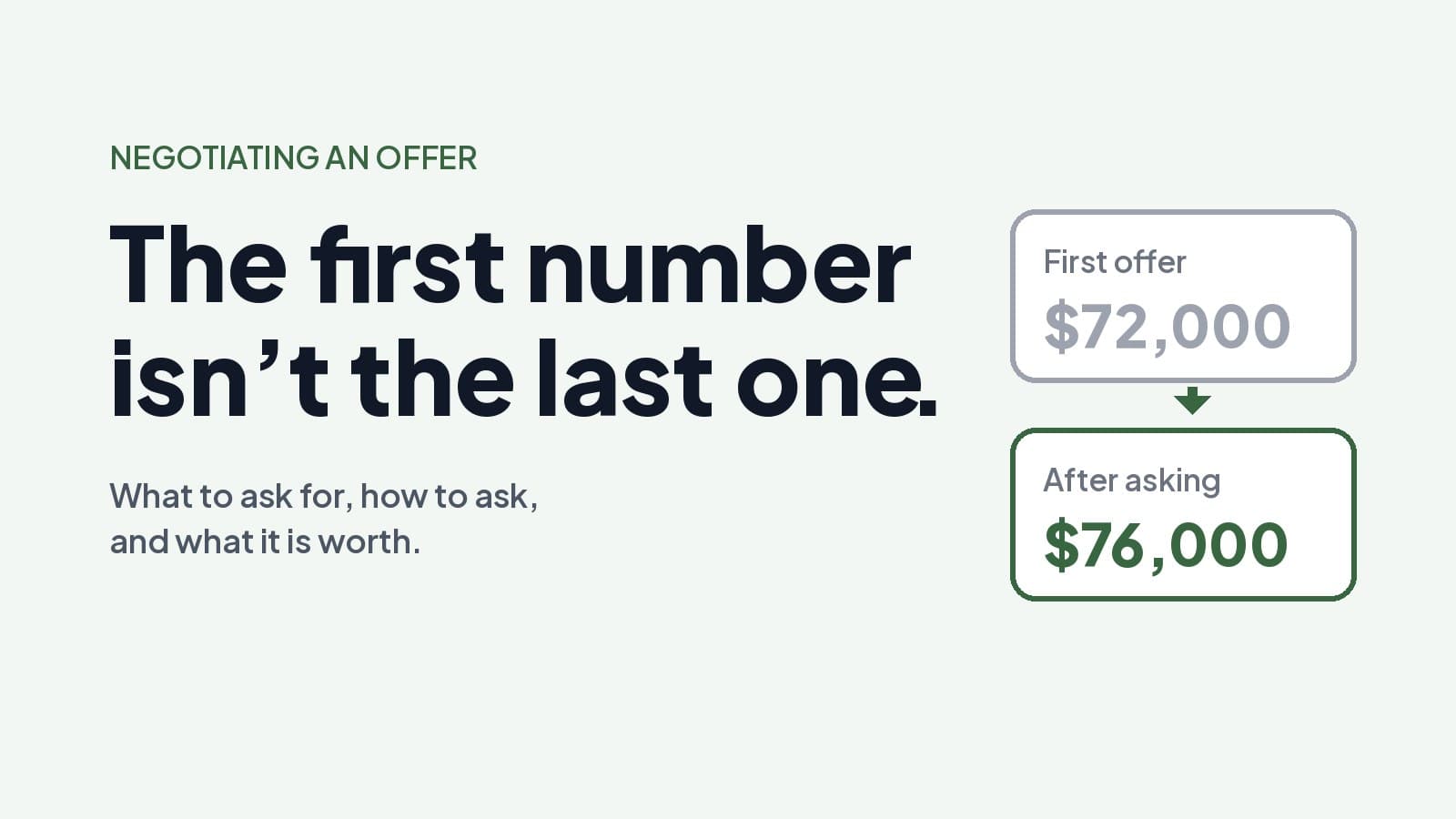
The most common mistake with a first job offer isn't asking for too much. It's not asking at all — accepting the opening number because it's more than you've earned before, or because asking feels like it might cost you the job.
It almost never does. A polite, specific question about the offer is an ordinary part of hiring, and the realistic worst case is a straightforward "this is our best offer" — after which you accept exactly what you would have accepted anyway. An offer that is withdrawn because somebody asked respectfully is rare enough that, if it happens, it tells you something about the place you would have been working.
Why a few thousand at the start is worth much more than a few thousand
Raises are usually a percentage of your current pay. So a higher starting base doesn't pay off once — it is carried into every raise after it. Take $4,000 more in starting salary and assume 3% raises a year: over ten years that one conversation is worth about $45,900 in extra pay, and by year ten the gap is over $5,200 a year on its own. That is before anything it adds to a 401(k) match, which is also a percentage of pay.
The same conversation is never cheaper than it is now. Once you have accepted, the next chance to move your base is a review cycle, and a raise there is usually a few percent of a number you have already agreed to.
What to ask for — it isn't only salary
Base salary is the ask that compounds, so it is usually the first one. But when a company can't move base — a set band, a fixed new-grad rate — other parts of an offer are often easier to change:
- A signing bonus. Paid once, so it doesn't raise the company's cost every year. Often the easiest yes.
- Relocation. Moving costs are real and one-off; covering them is routine for many employers.
- Start date. Free to give, and worth a lot if you need time to move or finish something.
- Time off. An extra week has a cash value — a week of your pay.
- Equity, where it's offered, and when the next salary review happens.
Internships are the case where the pay rate is most often fixed for every intern in the program. Ask anyway, politely — and if the rate can't move, ask about housing, relocation or travel, which often can.
If you don't know which of these is worth the most for your offer, the offer calculator prices each one off your own numbers in its "Before you counter" card — so you can ask for the thing that actually moves the total.
How to ask
- Say you're excited first, and mean it. The ask lands as "I want to make this work," not as a threat.
- Ask for one specific number. "Is there flexibility on base?" invites a vague answer. "Could you get to $76,000?" gets a real one.
- Give one honest reason. Another offer, the cost of living in the city, or what similar roles pay. Never invent a competing offer — it is easy to check and it ends the conversation if it is.
- Ask once, then stop. One clear request, and let them come back. You don't need to justify it three times.
- Get the final terms in writing before you accept.
Something as short as this is enough:
Thank you — I'm really excited about this role and the team. Before I sign, I wanted to ask whether there's room on the base salary. Given the cost of living in Austin, $76,000 would make this an easy yes for me. Is that something you could do?
If they say no
Then you know the offer is as good as it gets, and you can decide on it clearly — which is the point. Thank them, and if base can't move, it's fair to ask once about one of the other items above. Then accept or decline on the merits, without apologising for having asked.
👉 See what your offer is really worth, and which ask moves it most
General guidance, not legal or employment advice. Practices differ by company, industry and country, and this page has no salary benchmark data for your role.